


Read this record in : Français · العربية
Pellitory of Spain (Anacyclus pyrethrum (L.) Link) — Botanical description, ecology and distribution in Morocco
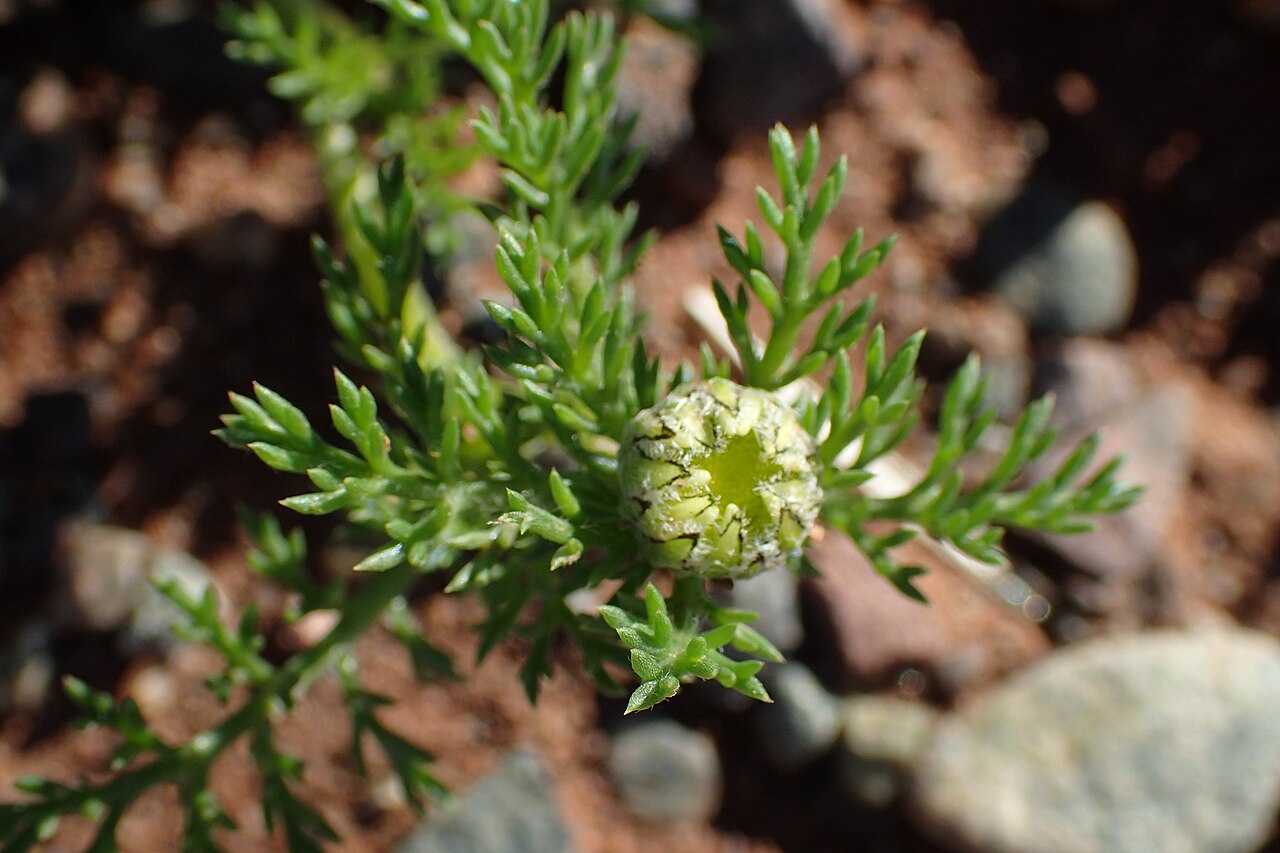

Vulnerable (IUCN) aromatic and medicinal plant, locally extinct through overharvesting; monitored by AFMI in Ifrane National Park.
AFMI projects : CEPF-110406 (2020–2022)

Scan to open this record
1. Introduction
Pellitory of Spain (Anacyclus pyrethrum), known in Morocco as ʿūd al-qarḥ, is a small perennial in the daisy family (Asteraceae). Its root has a burning taste and is highly sought after in traditional medicine.
Listed as Vulnerable by IUCN, it is reported as locally extinct in the area of AFMI’s CEPF project, because of overgrazing and root harvesting.
2. Taxonomic classification
| Rank | Taxon |
|---|---|
| Kingdom | Plantae |
| Division | Magnoliophyta |
| Class | Magnoliopsida |
| Order | Asterales |
| Family | Asteraceae |
| Genus | Anacyclus |
| Species | Anacyclus pyrethrum (L.) Link |
3. Botanical description
3.1. General habit
Low perennial with stems first lying then rising, 10 to 30 cm long, from a thick, fleshy taproot.
3.2. Leaves
Finely divided, slightly fleshy, greyish-green leaves, mostly grouped at the base.
3.3. Inflorescence
Solitary flower heads at the tips of stems, 2 to 4 cm across.
3.4. Flower heads and flowers
Heads with a yellow centre surrounded by white ray florets that are purple-red underneath, so the bud looks red. Flowering in spring.
3.5. Fruits and seeds
Flattened, winged achenes that fall when ripe in early summer.
4. Ecology and environmental requirements
A species of mountain grasslands and rocky ground, on well-drained, often calcareous soils.
Its deep root lets it withstand cold and drought.
5. Geographical distribution
5.1. Worldwide distribution
A species of North Africa (Morocco and Algeria) and southern Spain.
5.2. Distribution in North Africa and Morocco
Found mainly in the Atlas mountains, especially the Middle Atlas, where its populations have declined sharply.
6. Ecological and agricultural impacts
6.1. Pastoral value
Little eaten by livestock, it suffers mainly from trampling and general rangeland degradation.
6.2. Ecological role
It adds to the diversity of mountain grasslands and attracts many pollinating insects.
6.3. Effects on soils
Its taproot helps aerate and stabilise the soil.
6.4. Issues for livestock and conservation
Commercial root harvesting, often before seed set, is the main threat: every plant pulled up is lost for good. Overgrazing worsens its decline.
7. Outlook for Morocco
Growing it through local cooperatives, from seed stored in the AFMI seed bank, could reduce wild harvesting and create income.
Reintroducing it to rested plots in Ifrane National Park is an option to explore with the Park managers.
8. Conclusion
Pellitory of Spain shows the link between biodiversity and local knowledge. Saving it requires regulated harvesting, cultivation and rangeland rest.
9. Main references
- CEPF (2022). Final Completion and Impact Report, projet CEPF-110406, Association Forêt Modèle Ifrane.
- UICN – Liste rouge des espèces menacées : Anacyclus pyrethrum (VU).
- Fennane M. et al. (2014). Flore pratique du Maroc, vol. 3. Institut Scientifique, Rabat.
- Bellakhdar J. (1997). La pharmacopée marocaine traditionnelle. Ibis Press, Paris.
- POWO (2026). Anacyclus pyrethrum (L.) Link. Plants of the World Online, Royal Botanic Gardens, Kew.