


Read this record in : Français · العربية
Red fescue (Festuca rubra L.) — Botanical description, ecology and distribution in Morocco
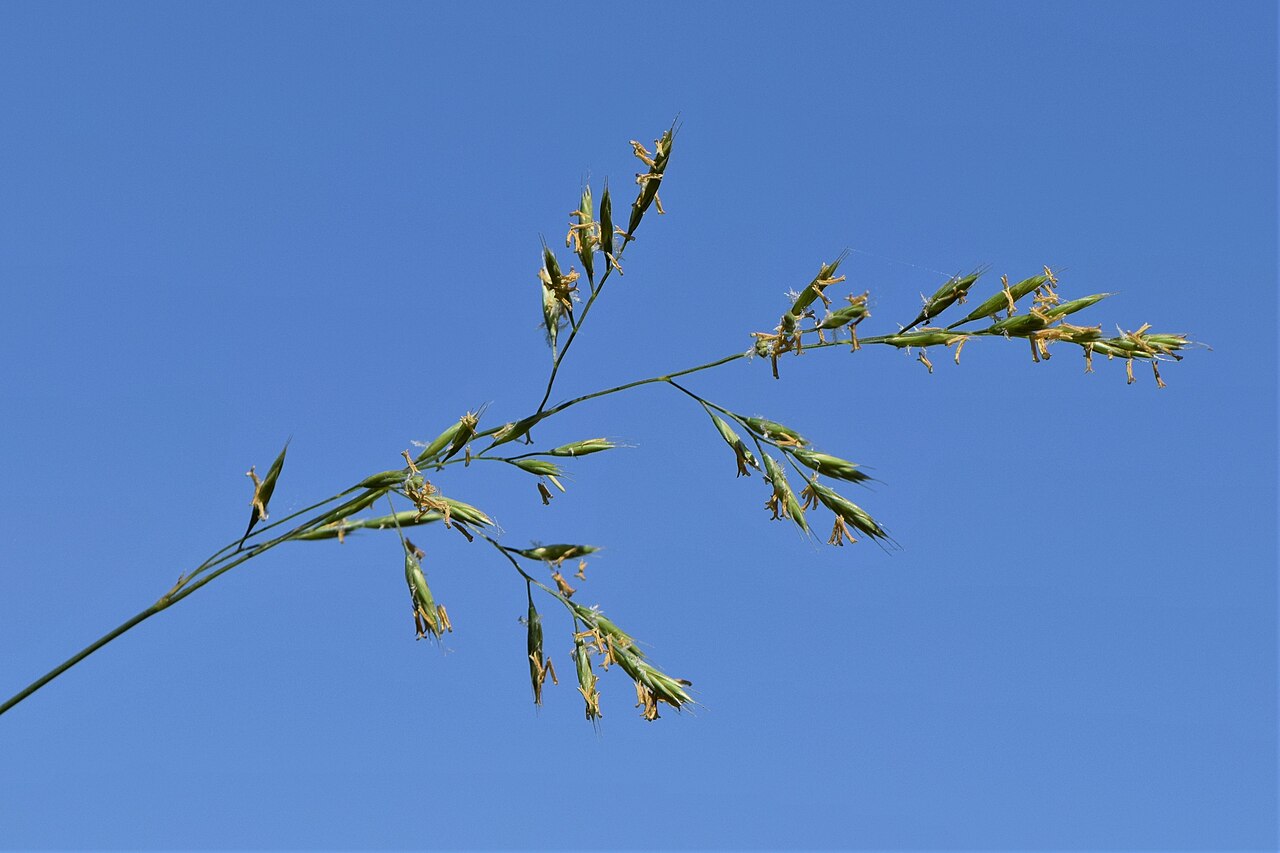

Perennial grass sown in mixtures by AFMI to restore degraded rangelands in Ifrane National Park.
AFMI projects : CEPF-110406 (2020–2022)

Scan to open this record
1. Introduction
Red fescue (Festuca rubra L.) is a perennial grass of cool meadows and grasslands. It takes its name from the reddish colour of its stem bases and spikelets.
In the Middle Atlas, it is one of the species AFMI sowed on degraded rangelands in Ifrane National Park, as part of the CEPF project to restore traditional grazing practices such as the Agdal.
2. Taxonomic classification
| Rank | Taxon |
|---|---|
| Kingdom | Plantae |
| Division | Magnoliophyta |
| Class | Liliopsida |
| Order | Poales |
| Family | Poaceae |
| Genus | Festuca |
| Species | Festuca rubra L. |
3. Botanical description
3.1. General habit
Perennial plant 20 to 70 cm tall, forming a dense sward through creeping rhizomes. Young shoots emerge outside the leaf sheath, which lets the plant spread and cover the ground.
3.2. Leaves
Basal leaves are fine, folded lengthwise and almost thread-like (0.5 to 1.5 mm). Stem leaves are wider and sometimes flat. Sheaths are fused into a tube and often reddish at the base; the ligule is very short.
3.3. Inflorescence
Loose panicle 3 to 15 cm long, upright or slightly nodding, often tinged purple or red when ripe.
3.4. Spikelets and flowers
Spikelets 7 to 14 mm long with 3 to 8 florets. The lemma ends in a short awn 1 to 3 mm long. Flowering runs from late spring to early summer, later at high altitude.
3.5. Fruits and seeds
The fruit is a narrow caryopsis about 3 to 4 mm long, which stays enclosed by the lemma and palea. Seeds are light and are harvested when the panicle is fully ripe.
4. Ecology and environmental requirements
A species of cool, moist climates, resistant to cold and frost. It tolerates moderate drought but suffers in long, hot summers.
It grows on a wide range of soils, even poor ones, preferably cool and acid to neutral. It occurs in mountain grasslands, clearings and open cedar and holm oak woodland.
5. Geographical distribution
5.1. Worldwide distribution
A circumboreal species found throughout Europe, temperate Asia and North America. It is widely grown for lawns and meadows.
5.2. Distribution in North Africa and Morocco
In Morocco, the red fescue group occurs in the mountains: the Rif, the Middle Atlas and the High Atlas. In the central Middle Atlas, local forms (var. atlantica) form continuous carpets under cedar and holm oak.
6. Ecological and agricultural impacts
6.1. Pastoral value
Fine forage, readily eaten by sheep when young. It becomes less palatable as the leaves age and harden. It regrows well after grazing if stocking remains moderate.
6.2. Ecological role
By forming a dense sward, it protects bare soil, limits the spread of less useful annual species and shelters small fauna.
6.3. Effects on soils
Its rhizome network holds soil on slopes and reduces erosion. It adds organic matter to the soil as its roots renew.
6.4. Issues for livestock and conservation
Its persistence depends on rangeland rest. The traditional grazing closure (Agdal) lets it flower and set seed before the flock returns.
7. Outlook for Morocco
Local red fescue seed is better adapted to the Middle Atlas climate than imported lawn varieties. Harvesting it and storing it in the AFMI seed bank supports rangeland restoration.
Monitoring the sown plots will show how well the plants establish and how much forage they produce.
8. Conclusion
Red fescue is a hardy perennial grass, useful for covering and stabilising the soils of mountain rangelands. Combined with pasture rest, it helps restore the rangelands of Ifrane National Park for the long term.
9. Main references
- CEPF (2022). Final Completion and Impact Report – Conservation de la biodiversité du Parc national d’Ifrane par la réhabilitation et l’adaptation des pratiques agricoles traditionnelles ancestrales (CEPF-110406), AFMI.
- Maire R. (1955). Flore de l’Afrique du Nord, vol. 3. Lechevalier, Paris.
- Fennane M. et al. (2014). Flore pratique du Maroc, vol. 3. Institut Scientifique, Rabat.
- Nègre R. (1952). Observations phytosociologiques et écologiques sommaires sur la cédraie de Kissarit (Aïn Leuh, Moyen Atlas central). Phyton 4 : 59–71.
- POWO (2026). Festuca rubra L. Plants of the World Online, Royal Botanic Gardens, Kew.