


Read this record in : Français · العربية
Annual ryegrass (Lolium rigidum Gaudin) — Botanical description, ecology and distribution in Morocco
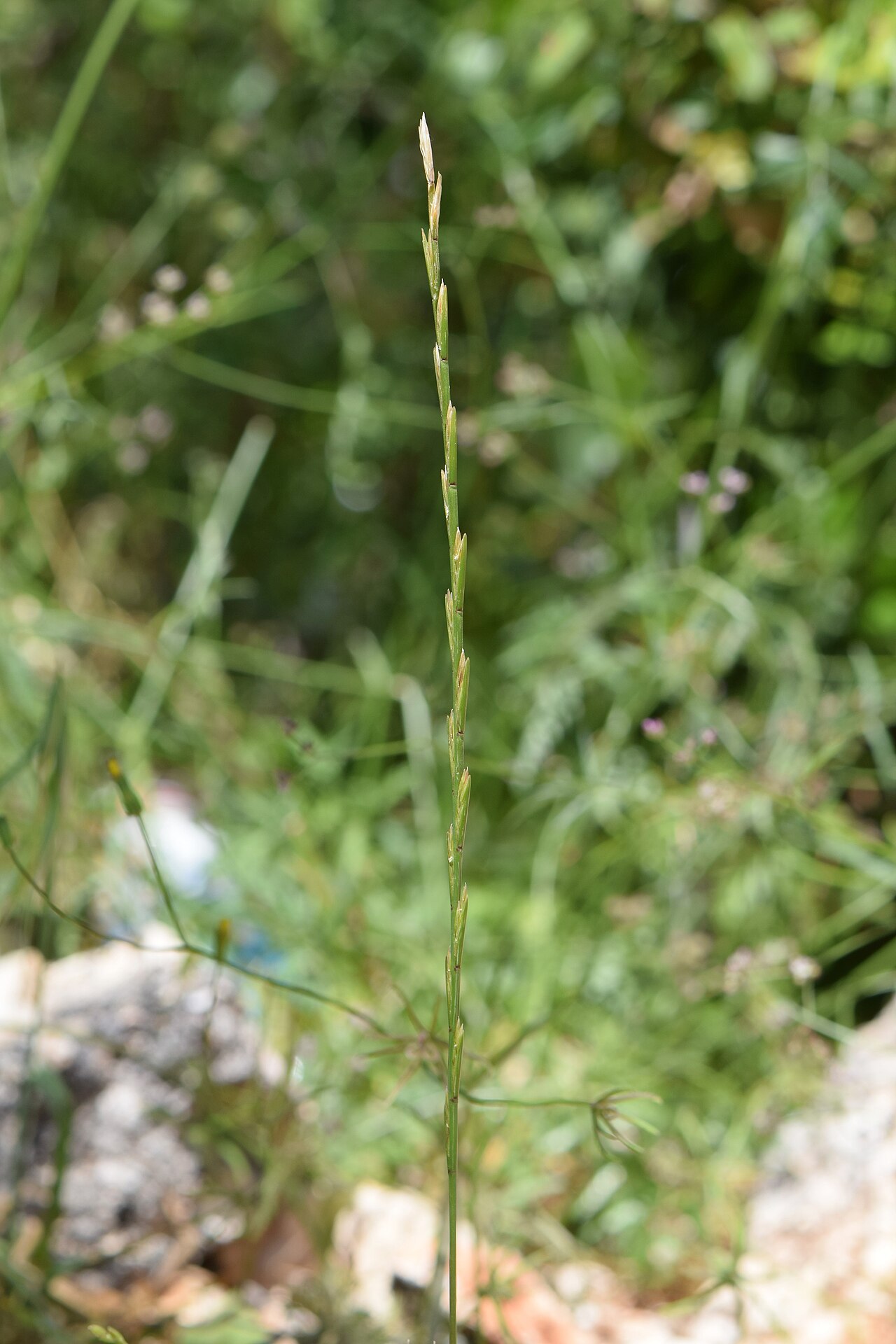

Annual grass sown in mixtures by AFMI on degraded rangelands in Ifrane National Park.
AFMI projects : CEPF-110406 (2020–2022)

Scan to open this record
1. Introduction
Annual or Wimmera ryegrass (Lolium rigidum Gaudin) is a Mediterranean annual grass related to cultivated ryegrasses. It is easy to recognise by its flat spike with spikelets set edgeways.
A good forage plant, it was sown by AFMI on degraded rangelands in Ifrane National Park (CEPF project).
2. Taxonomic classification
| Rank | Taxon |
|---|---|
| Kingdom | Plantae |
| Division | Magnoliophyta |
| Class | Liliopsida |
| Order | Poales |
| Family | Poaceae |
| Genus | Lolium |
| Species | Lolium rigidum Gaudin |
3. Botanical description
3.1. General habit
Annual plant 10 to 70 cm tall, tufted, with stems upright or bent at the base.
3.2. Leaves
Flat leaves 2 to 6 mm wide, dark green and glossy underneath. The auricles at the base of the blade are small; the ligule is short.
3.3. Inflorescence
Flat, stiff spike 5 to 25 cm long, with alternate spikelets set edgeways in hollows of the axis.
3.4. Spikelets and flowers
Spikelets 5 to 15 mm long with 3 to 10 florets. A single glume, as long as or longer than the spikelet. Lemmas usually awnless. Flowering from April to June.
3.5. Fruits and seeds
Elongated caryopsis 3 to 6 mm long, attached to its husks. Seeds drop when ripe and germinate with the autumn rains.
4. Ecology and environmental requirements
A species of cultivated land, fallows, roadsides and grasslands. It tolerates summer drought by completing its cycle in spring.
It prefers fairly deep, fertile soils but also copes with poor ones.
5. Geographical distribution
5.1. Worldwide distribution
Native to the Mediterranean basin and western Asia, it has been introduced to many regions, notably Australia, where it is grown for forage.
5.2. Distribution in North Africa and Morocco
Very common in Morocco, from the plains to the mountains, in fields, fallows and rangelands.
6. Ecological and agricultural impacts
6.1. Pastoral value
Excellent forage, highly palatable and nutritious before heading. It is valued by sheep, goats and cattle.
6.2. Ecological role
It covers the ground quickly and produces a lot of biomass. In cereal crops, it can become a competitive weed.
6.3. Effects on soils
Its dense fibrous roots improve surface soil structure and limit erosion.
6.4. Issues for livestock and conservation
In fields, it is known for resistance to some herbicides. On rangelands, its persistence depends on spring rest that lets it set seed.
7. Outlook for Morocco
Used with local perennial species, annual ryegrass can quickly increase forage production on restoration plots.
8. Conclusion
Annual ryegrass is a productive, palatable annual. Well managed, it provides quality forage and helps cover degraded soils.
9. Main references
- CEPF (2022). Final Completion and Impact Report, projet CEPF-110406, Association Forêt Modèle Ifrane.
- Maire R. (1955). Flore de l’Afrique du Nord, vol. 3. Lechevalier, Paris.
- Fennane M. et al. (2014). Flore pratique du Maroc, vol. 3. Institut Scientifique, Rabat.
- POWO (2026). Lolium rigidum Gaudin. Plants of the World Online, Royal Botanic Gardens, Kew.