


Read this record in : Français · العربية
Dimorphic ash (Fraxinus dimorpha Coss. & Durieu) — Botanical description, ecology and distribution in Morocco
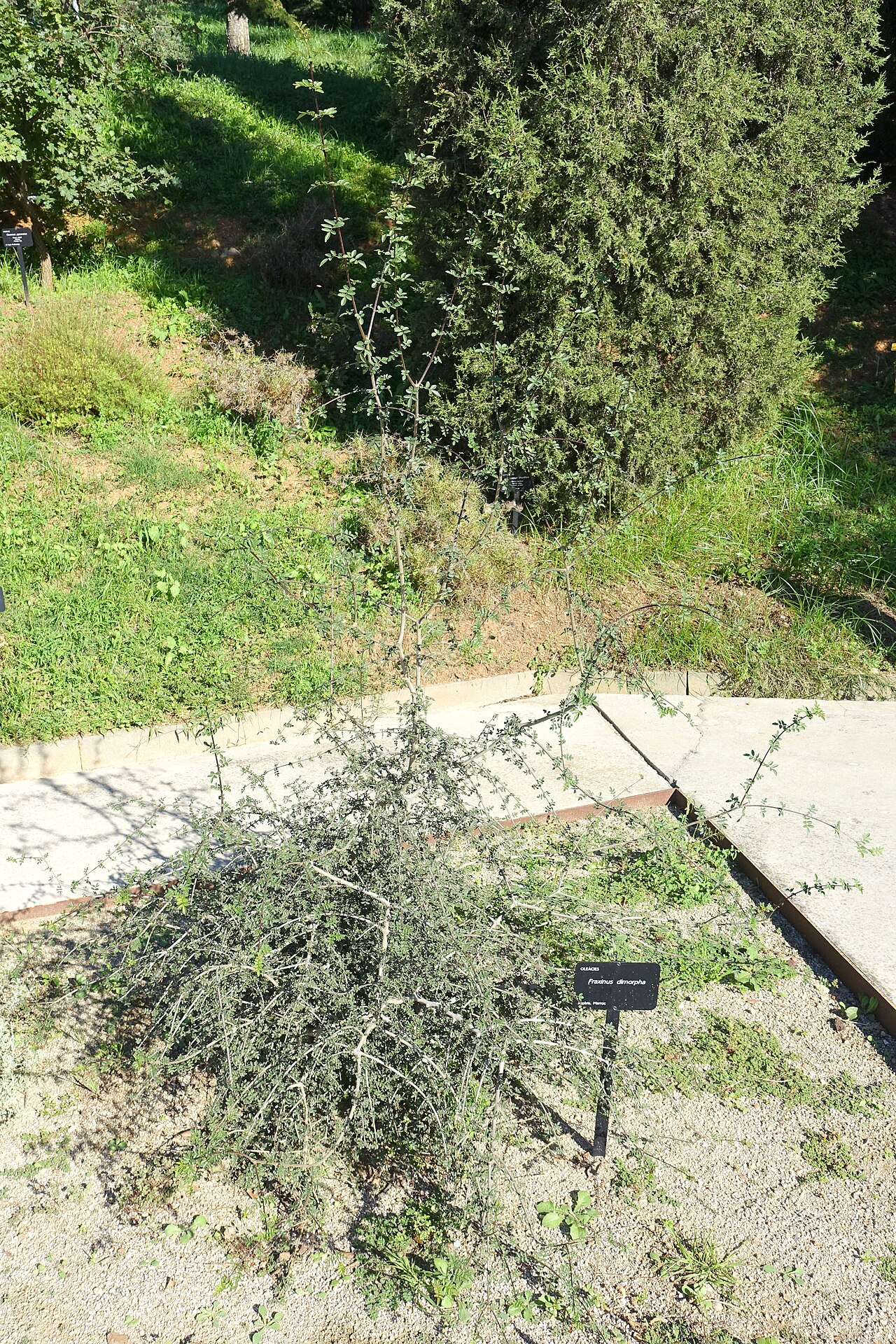

Fodder tree threatened by overgrazing and excessive cutting; monitored by AFMI in Ifrane National Park.
AFMI projects : CEPF-110406 (2020–2022)

Scan to open this record
1. Introduction
Dimorphic ash (Fraxinus dimorpha), called imts in Amazigh and derdar in Arabic, is a small North African tree. It is named after its two forms: a compact, small-leaved bush when browsed, and a tree with larger leaves when protected.
AFMI’s CEPF project monitored it as a species threatened by overgrazing. Stopping top-cutting and lopping in 2022 improved the health of the trees.
2. Taxonomic classification
| Rank | Taxon |
|---|---|
| Kingdom | Plantae |
| Division | Magnoliophyta |
| Class | Magnoliopsida |
| Order | Lamiales |
| Family | Oleaceae |
| Genus | Fraxinus |
| Species | Fraxinus dimorpha Coss. & Durieu |
3. Botanical description
3.1. General habit
Small deciduous tree or shrub a few metres tall. In grazed areas, it often takes the form of a dense bush, or a pollard shaped by herders.
3.2. Leaves
Opposite leaves made of small toothed leaflets. Their size varies greatly between the bushy and tree forms.
3.3. Inflorescence
Small clustered inflorescences appearing in spring.
3.4. Flowers
Inconspicuous, petal-less flowers pollinated by the wind.
3.5. Fruits and seeds
Elongated samaras (winged fruits) dispersed by the wind. In the High Atlas, its fruits are used in some spice blends.
4. Ecology and environmental requirements
A species of mountain climates with strong temperature swings: very cold winters and hot summers.
It grows in pastures, mountain plains, river banks and riverbeds.
5. Geographical distribution
5.1. Worldwide distribution
Endemic to North Africa: Morocco and Algeria, where it remains local and rare.
5.2. Distribution in North Africa and Morocco
Found locally and uncommonly in the High Atlas and the Middle Atlas, where it sometimes forms agroforestry parklands managed by local people.
6. Ecological and agricultural impacts
6.1. Pastoral value
A highly valuable fodder tree: its leaves provide quality forage in autumn, when the grass is dry. In some High Atlas villages, they cover about half of the flock’s food needs at that time.
6.2. Ecological role
A keystone species of mountain agro-sylvo-pastoral systems. It also provides wood, roof poles and medicinal and dye products.
6.3. Effects on soils
Recent studies show that traditional pollarding helps maintain soil fertility under the trees.
6.4. Issues for livestock and conservation
Listed as Endangered on the IUCN Red List (2017). Overgrazing, excessive cutting and drought threaten its stands. Careful pruning and rangeland rest are needed for it to regenerate.
7. Outlook for Morocco
Protecting young plants, raising seedlings from local seed and building on herders’ knowledge are ways to safeguard it.
AFMI’s monitoring shows that a change in practices can quickly improve the condition of the trees.
8. Conclusion
Dimorphic ash is a heritage tree, both threatened and essential to mountain herders. Its conservation relies on combining traditional knowledge and sustainable management.
9. Main references
- CEPF (2022). Final Completion and Impact Report, projet CEPF-110406, Association Forêt Modèle Ifrane.
- Rankou H. et al. (2017). Fraxinus dimorpha. Liste rouge de l’UICN des espèces menacées (EN).
- Genin D. & Alifriqui M. (2019). Les frênes dimorphes du Haut Atlas. L’agroforesterie en pratique dans le monde, Association française d’agroforesterie.
- Fakhech A. et al. (2020). Traditional pollarding practices for dimorphic ash tree (Fraxinus dimorpha) support soil fertility in the Moroccan High Atlas. Land 9 : 334.
- POWO (2026). Fraxinus dimorpha Coss. & Durieu. Plants of the World Online, Royal Botanic Gardens, Kew.