


Read this record in : Français · العربية
Purple false brome (Brachypodium distachyon (L.) P.Beauv.) — Botanical description, ecology and distribution in Morocco
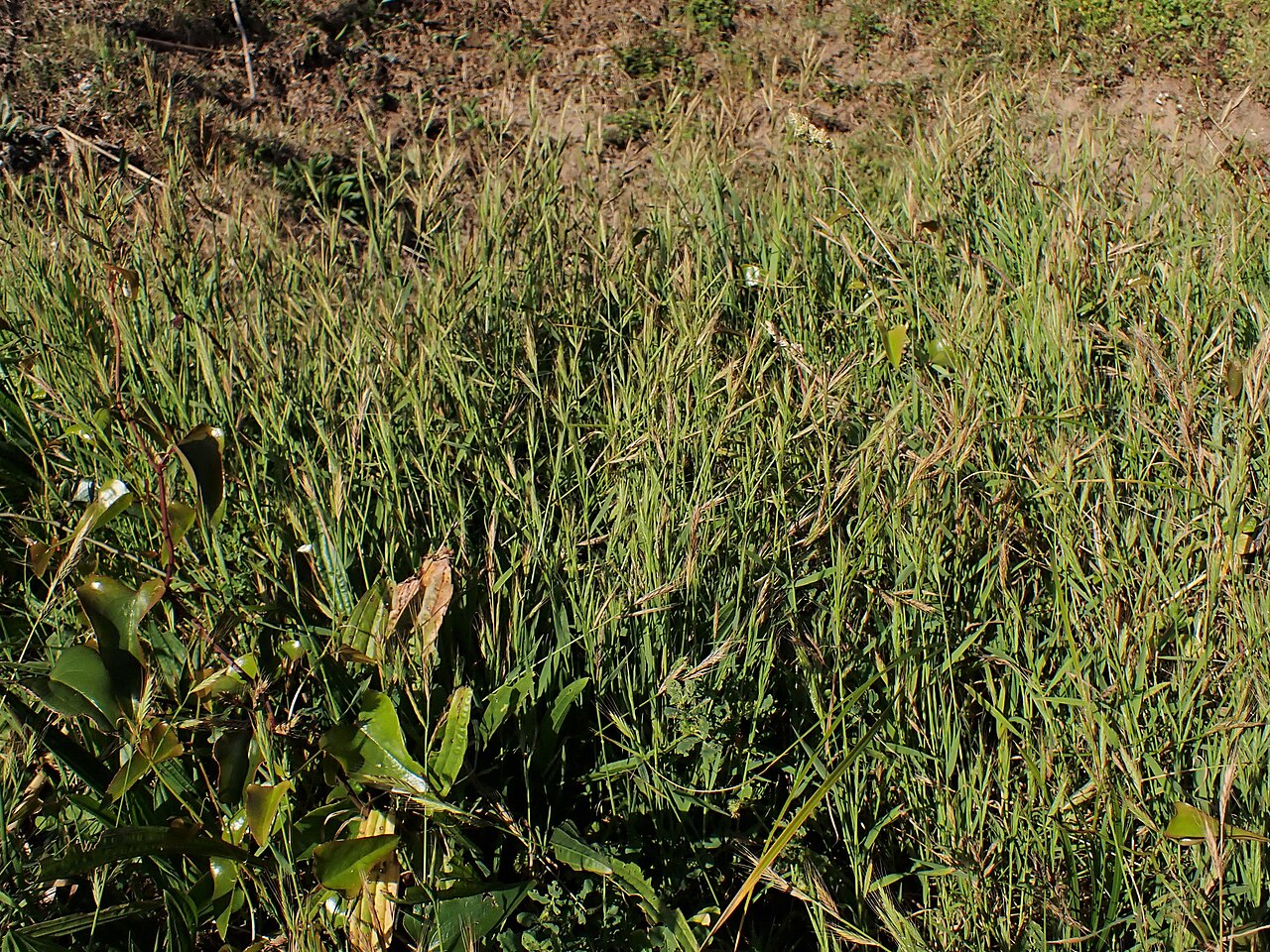

Annual grass sown in mixtures by AFMI on degraded rangelands in Ifrane National Park.
AFMI projects : CEPF-110406 (2020–2022)

Scan to open this record
1. Introduction
Purple false brome (Brachypodium distachyon) is a small annual grass of Mediterranean grasslands. It usually bears two or three elongated spikelets at the top of the stem.
Well known to researchers as a model plant for studying cereals, it is also one of the species AFMI sowed on rangelands in Ifrane National Park (CEPF project).
2. Taxonomic classification
| Rank | Taxon |
|---|---|
| Kingdom | Plantae |
| Division | Magnoliophyta |
| Class | Liliopsida |
| Order | Poales |
| Family | Poaceae |
| Genus | Brachypodium |
| Species | Brachypodium distachyon (L.) P.Beauv. |
3. Botanical description
3.1. General habit
Annual plant 5 to 35 cm tall, with slender stems, upright or bent at the base, often in small tufts.
3.2. Leaves
Short, flat leaves 2 to 5 mm wide, slightly rough and sometimes hairy. The ligule is short and fringed.
3.3. Inflorescence
Very short raceme of 1 to 5 spikelets (often 2 or 3), almost stalkless, upright along the axis.
3.4. Spikelets and flowers
Elongated spikelets 15 to 35 mm long with 7 to 20 florets. The lemma has a straight awn 7 to 15 mm long. Flowering from March to May.
3.5. Fruits and seeds
Elongated caryopsis 5 to 8 mm long, attached to the palea. The life cycle is short: a few months from germination to seed.
4. Ecology and environmental requirements
A species of dry grasslands, garrigue and path edges. It copes with drought by completing its cycle before summer.
It grows on poor, often calcareous and shallow soils, in the lowlands and mid-mountains.
5. Geographical distribution
5.1. Worldwide distribution
Native to the Mediterranean basin and the Middle East, it has been introduced to other Mediterranean-climate regions (California, Australia).
5.2. Distribution in North Africa and Morocco
Very widespread in Morocco, in grasslands, scrub and rangelands, from the plains up to the Atlas mountains.
6. Ecological and agricultural impacts
6.1. Pastoral value
Early forage eaten by sheep and goats in early spring. Its value drops quickly after flowering, when the awns harden.
6.2. Ecological role
It is among the first plants to cover bare ground after the rains and adds to the diversity of annual grasslands.
6.3. Effects on soils
Its shallow roots limit surface erosion on thin, stony soils.
6.4. Issues for livestock and conservation
Its persistence depends on yearly seed production. Spring rest on rangelands rebuilds the soil seed bank.
7. Outlook for Morocco
Easy to multiply, it suits starter sowings on heavily degraded rangelands, together with perennials.
8. Conclusion
Purple false brome is an early, undemanding annual. It helps cover the soil and provides useful forage in early spring.
9. Main references
- CEPF (2022). Final Completion and Impact Report, projet CEPF-110406, Association Forêt Modèle Ifrane.
- Maire R. (1955). Flore de l’Afrique du Nord, vol. 3. Lechevalier, Paris.
- Fennane M. et al. (2014). Flore pratique du Maroc, vol. 3. Institut Scientifique, Rabat.
- POWO (2026). Brachypodium distachyon (L.) P.Beauv.. Plants of the World Online, Royal Botanic Gardens, Kew.
- International Brachypodium Initiative (2010). Genome sequencing and analysis of the model grass Brachypodium distachyon. Nature 463 : 763–768.