


Read this record in : Français · العربية
Phleum subulatum (Savi) Asch. & Graebn. — Botanical description, ecology and distribution in Morocco
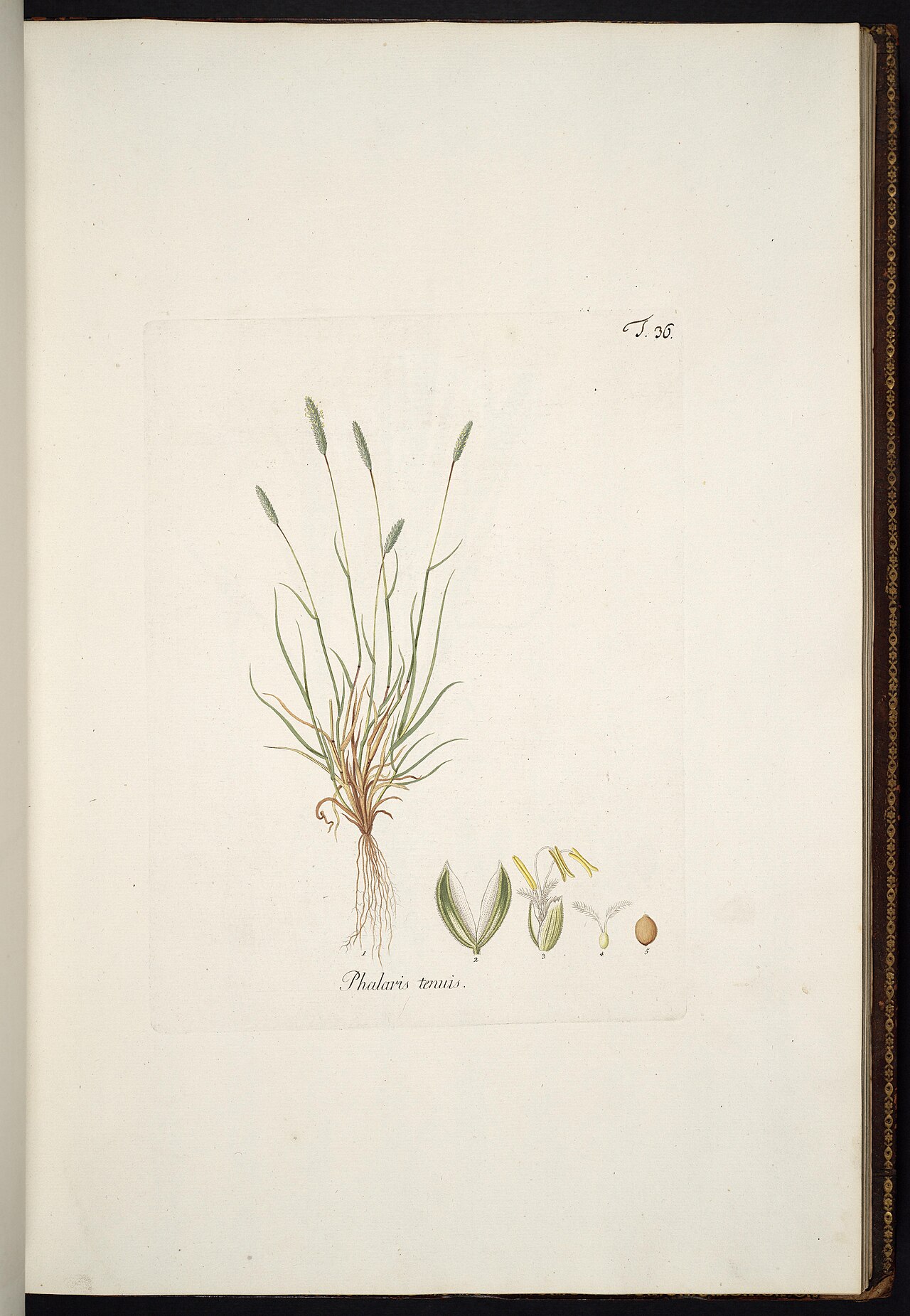

Annual grass sown in mixtures by AFMI on degraded rangelands in Ifrane National Park.
AFMI projects : CEPF-110406 (2020–2022)

Scan to open this record
1. Introduction
Phleum subulatum is a small annual Mediterranean grass. Its thin, pointed spike recalls an awl.
It is one of the species AFMI sowed to re-cover degraded rangelands in Ifrane National Park (CEPF project).
2. Taxonomic classification
| Rank | Taxon |
|---|---|
| Kingdom | Plantae |
| Division | Magnoliophyta |
| Class | Liliopsida |
| Order | Poales |
| Family | Poaceae |
| Genus | Phleum |
| Species | Phleum subulatum (Savi) Asch. & Graebn. |
3. Botanical description
3.1. General habit
Slender annual plant 5 to 40 cm tall, with stems upright or spreading at the base, single or in small tufts.
3.2. Leaves
Flat, narrow, hairless leaves 1 to 4 mm wide. Upper sheaths are slightly inflated; the ligule is membranous.
3.3. Inflorescence
Narrow, cylindrical, spike-like panicle 2 to 10 cm long, clearly tapering towards the tip.
3.4. Spikelets and flowers
Very small spikelets (2 to 3 mm) with a single floret, packed along the axis. Glumes end in a short point. Flowering from April to June.
3.5. Fruits and seeds
Tiny caryopsis under 1.5 mm. The plant produces many light seeds that keep it present from year to year.
4. Ecology and environmental requirements
A species of open grasslands, dry soils and path edges. It escapes drought by completing its cycle in spring.
It tolerates poor, shallow soils, whether calcareous or siliceous.
5. Geographical distribution
5.1. Worldwide distribution
A Mediterranean species, from southern Europe to western Asia and North Africa.
5.2. Distribution in North Africa and Morocco
Widespread across much of Morocco, from the plains to the mountains, in grasslands and open rangelands.
6. Ecological and agricultural impacts
6.1. Pastoral value
Fine, palatable forage in spring, but in small amounts because of its size. It supplements the sheep diet early in the season.
6.2. Ecological role
It quickly colonises bare patches and adds to the diversity of annual grasslands.
6.3. Effects on soils
Its fine roots protect the soil surface against crusting and runoff from autumn and spring rain.
6.4. Issues for livestock and conservation
Like any annual, it must set seed every year. Spring rest on rangelands keeps its seed stock renewed.
7. Outlook for Morocco
Combined with perennials, it can help quickly cover the soil of restoration plots in the Middle Atlas.
8. Conclusion
Phleum subulatum is a modest but useful annual: it covers the ground quickly and provides fine forage in spring.
9. Main references
- CEPF (2022). Final Completion and Impact Report, projet CEPF-110406, Association Forêt Modèle Ifrane.
- Maire R. (1955). Flore de l’Afrique du Nord, vol. 3. Lechevalier, Paris.
- Fennane M. et al. (2014). Flore pratique du Maroc, vol. 3. Institut Scientifique, Rabat.
- POWO (2026). Phleum subulatum (Savi) Asch. & Graebn.. Plants of the World Online, Royal Botanic Gardens, Kew.