


Read this record in : Français · العربية
Koeleria splendens C.Presl — Botanical description, ecology and distribution in Morocco
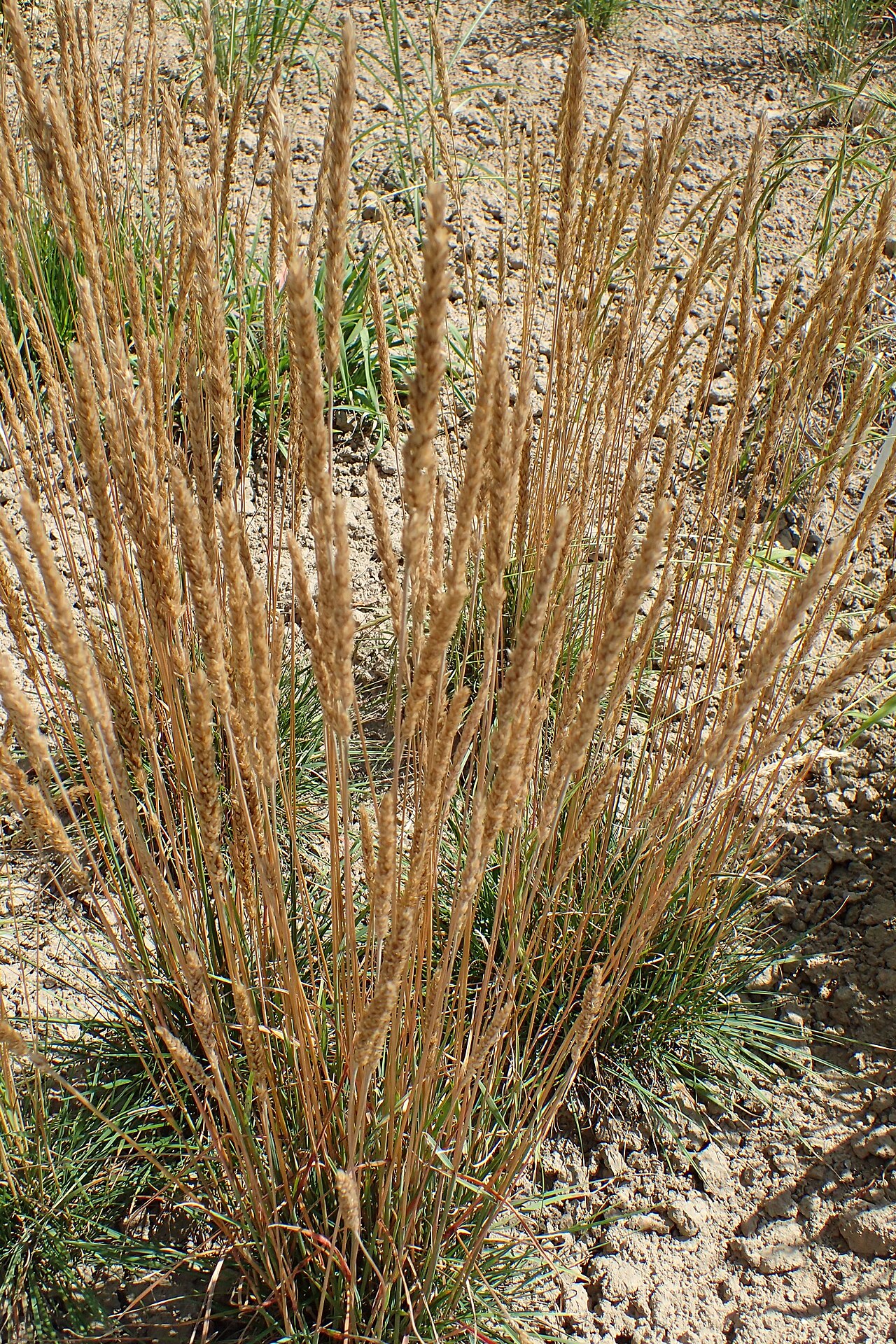

Perennial grass sown in mixtures by AFMI on degraded rangelands in Ifrane National Park.
AFMI projects : CEPF-110406 (2020–2022)

Scan to open this record
1. Introduction
Koeleria splendens C.Presl is a perennial grass of dry, rocky Mediterranean grasslands. Its shiny spikes gave it its name.
AFMI sowed it on degraded rangelands in Ifrane National Park as part of the CEPF project.
2. Taxonomic classification
| Rank | Taxon |
|---|---|
| Kingdom | Plantae |
| Division | Magnoliophyta |
| Class | Liliopsida |
| Order | Poales |
| Family | Poaceae |
| Genus | Koeleria |
| Species | Koeleria splendens C.Presl |
3. Botanical description
3.1. General habit
Perennial plant in dense tufts 15 to 50 cm tall. The stem bases are wrapped in the fibrous remains of old sheaths, which protect the plant from cold and drought.
3.2. Leaves
Narrow, often rolled, stiff, greyish-green leaves. The ligule is very short.
3.3. Inflorescence
Dense, cylindrical, spike-like panicle 2 to 8 cm long, shiny, silvery to light brown.
3.4. Spikelets and flowers
Flattened spikelets 4 to 7 mm long with 2 to 3 florets. Glumes and lemmas are glossy with membranous margins. Flowering from May to July.
3.5. Fruits and seeds
Small caryopsis 2 to 3 mm long, enclosed in the lemma. Seeds fall when ripe in early summer.
4. Ecology and environmental requirements
A species of dry, stony, often calcareous, sunny soils. It withstands summer drought and winter cold well.
It occurs in open grasslands, clearings and mid-mountain rangelands.
5. Geographical distribution
5.1. Worldwide distribution
A Mediterranean species found in southern Europe and North Africa.
5.2. Distribution in North Africa and Morocco
Found in the mountains of Morocco, notably in dry, rocky grasslands of the Middle Atlas.
6. Ecological and agricultural impacts
6.1. Pastoral value
Fine forage eaten by sheep, especially in spring when the leaves are tender. Its yield is modest but steady, even in dry years.
6.2. Ecological role
Its dense tufts stabilise dry grasslands and shelter many insects.
6.3. Effects on soils
The tufts trap fine soil and plant debris, helping to rebuild soil on stony slopes.
6.4. Issues for livestock and conservation
A slow-growing perennial, it suffers from repeated overgrazing. Rangeland rest lets it set seed and spread.
7. Outlook for Morocco
Its drought resistance makes it a good candidate for restoring dry rangelands in the Middle Atlas as the climate changes.
8. Conclusion
Koeleria splendens is a frugal, resilient perennial, useful for stabilising dry grasslands and providing forage even in difficult years.
9. Main references
- CEPF (2022). Final Completion and Impact Report, projet CEPF-110406, Association Forêt Modèle Ifrane.
- Maire R. (1955). Flore de l’Afrique du Nord, vol. 3. Lechevalier, Paris.
- Fennane M. et al. (2014). Flore pratique du Maroc, vol. 3. Institut Scientifique, Rabat.
- POWO (2026). Koeleria splendens C.Presl. Plants of the World Online, Royal Botanic Gardens, Kew.