


Read this record in : Français · العربية
Soft brome (Bromus mollis L.) — Botanical description, ecology and distribution in Morocco
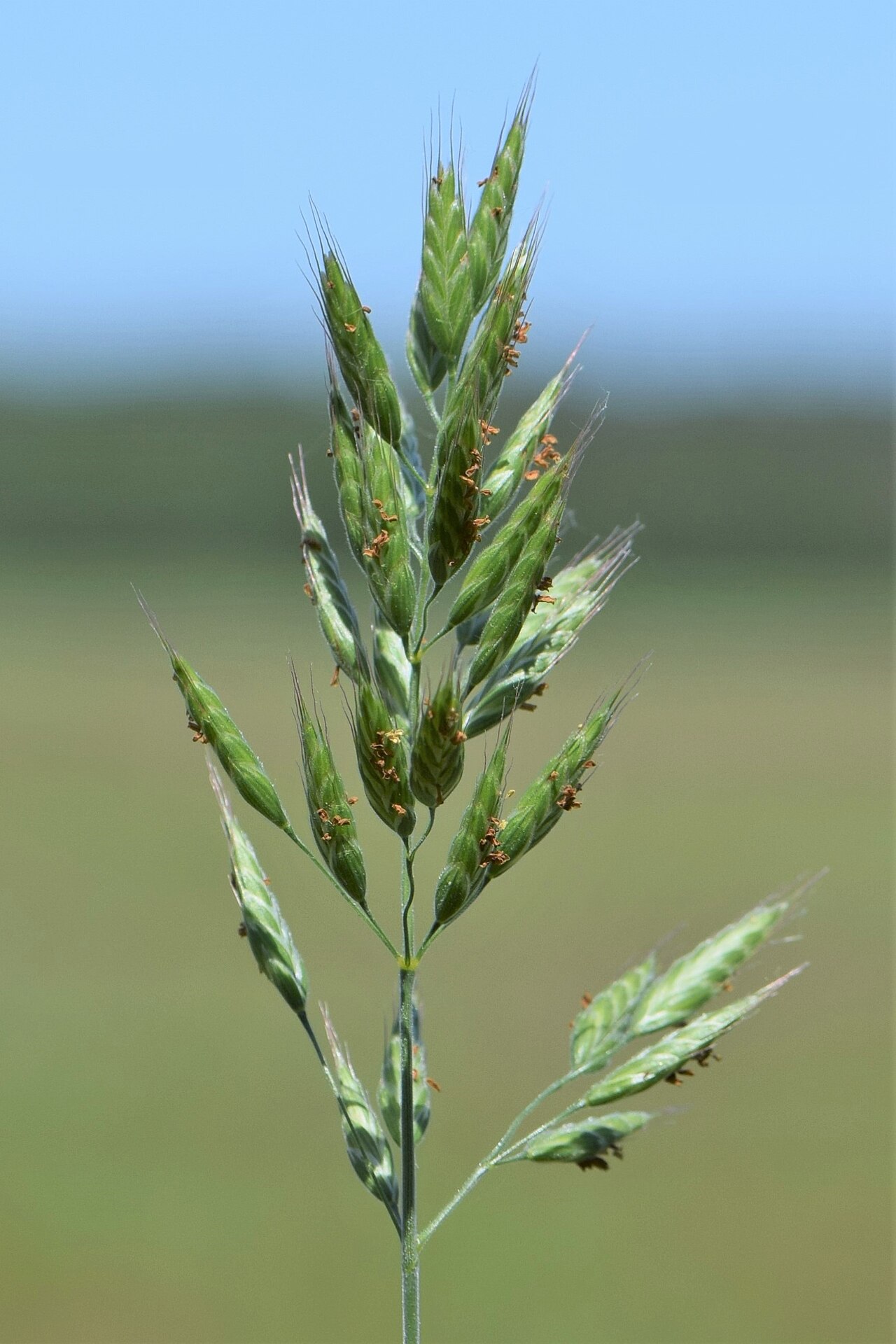

Annual grass sown in mixtures by AFMI on degraded rangelands in Ifrane National Park.
AFMI projects : CEPF-110406 (2020–2022)

Scan to open this record
1. Introduction
Soft brome (Bromus mollis L., now often called Bromus hordeaceus L.) is a very common annual grass of meadows, fallow land and roadsides. Its name comes from its soft, hairy spikelets.
It is one of the species AFMI sowed to quickly re-cover bare ground on the rangelands of Ifrane National Park (CEPF project).
2. Taxonomic classification
| Rank | Taxon |
|---|---|
| Kingdom | Plantae |
| Division | Magnoliophyta |
| Class | Liliopsida |
| Order | Poales |
| Family | Poaceae |
| Genus | Bromus |
| Species | Bromus mollis L. (= B. hordeaceus L.) |
3. Botanical description
3.1. General habit
Annual plant 10 to 60 cm tall, in loose tufts, with upright stems sometimes bent at the base. The whole plant is often covered in soft hairs.
3.2. Leaves
Flat leaves 2 to 6 mm wide, hairy on both sides. Sheaths are closed and densely hairy; the ligule is short and toothed.
3.3. Inflorescence
Upright, fairly compact panicle 3 to 10 cm long, with short branches carrying 1 to 3 spikelets.
3.4. Spikelets and flowers
Ovoid, hairy spikelets 12 to 20 mm long with 6 to 12 florets. The lemma has a straight awn 5 to 10 mm long. Flowering from April to June.
3.5. Fruits and seeds
Elongated caryopsis about 6 to 8 mm long, attached to the palea. The plant produces many seeds that germinate with the first autumn rains.
4. Ecology and environmental requirements
A pioneer of disturbed, compacted or grazed soils. It copes with summer drought by completing its life cycle before summer.
It grows on many soil types, often nitrogen-rich, from the lowlands to mid-mountain areas.
5. Geographical distribution
5.1. Worldwide distribution
Native to Europe, North Africa and western Asia, it has naturalised in temperate regions worldwide.
5.2. Distribution in North Africa and Morocco
Very common throughout Morocco, from the coast to the Atlas mountains. In the Middle Atlas, it is frequent on rangelands and fallow land.
6. Ecological and agricultural impacts
6.1. Pastoral value
Good spring forage, readily eaten by sheep and goats before heading. Its value drops as the ears ripen and the awns harden.
6.2. Ecological role
It quickly covers bare soil after the rains, preparing the ground for slower-growing perennial species.
6.3. Effects on soils
Its fibrous root system holds topsoil during the wet season and reduces runoff.
6.4. Issues for livestock and conservation
As an annual, it relies on setting seed every year. Early, continuous grazing prevents reproduction; spring rest (Agdal) favours it.
7. Outlook for Morocco
Easy to harvest and sow, soft brome is useful for starting the restoration of degraded rangelands, mixed with perennials.
Local seed stored in the AFMI seed bank ensures good adaptation to the Middle Atlas climate.
8. Conclusion
Soft brome is a hardy, productive annual. Combined with perennial species and pasture rest, it helps quickly re-cover the soils of degraded rangelands.
9. Main references
- CEPF (2022). Final Completion and Impact Report, projet CEPF-110406, Association Forêt Modèle Ifrane.
- Maire R. (1955). Flore de l’Afrique du Nord, vol. 3. Lechevalier, Paris.
- Fennane M. et al. (2014). Flore pratique du Maroc, vol. 3. Institut Scientifique, Rabat.
- POWO (2026). Bromus hordeaceus L.. Plants of the World Online, Royal Botanic Gardens, Kew.